Kanchanaburi from Bangkok
The railway to Burma was built by forced labor at a cost of more than a hundred thousand lives. The town on the River Khwae holds the bridge, the graves, and the record — and asks a day taken seriously.
The short version
- Trains leave Bangkok’s Thonburi station twice daily for Kanchanaburi on the surviving line — about three hours at a flat tourist fare of around 100 baht, unreserved; buses from the Southern Terminal run more often and slightly faster.
- The Burma Railway, driven through 415 kilometers of jungle and rock in 1942–43 under the Imperial Japanese Army, was built by some 60,000 Allied prisoners of war and a far larger conscripted Asian labor force; the dead numbered over 100,000.
- The Kanchanaburi War Cemetery holds nearly 7,000 Commonwealth and Dutch graves, maintained by the Commonwealth War Graves Commission — rows kept with a care that says what needs saying; records at cwgc.org.
- The Thailand–Burma Railway Centre beside the cemetery is the serious museum: the railway’s engineering, the camps, the medicine, and the human ledger, presented with research-grade accuracy.
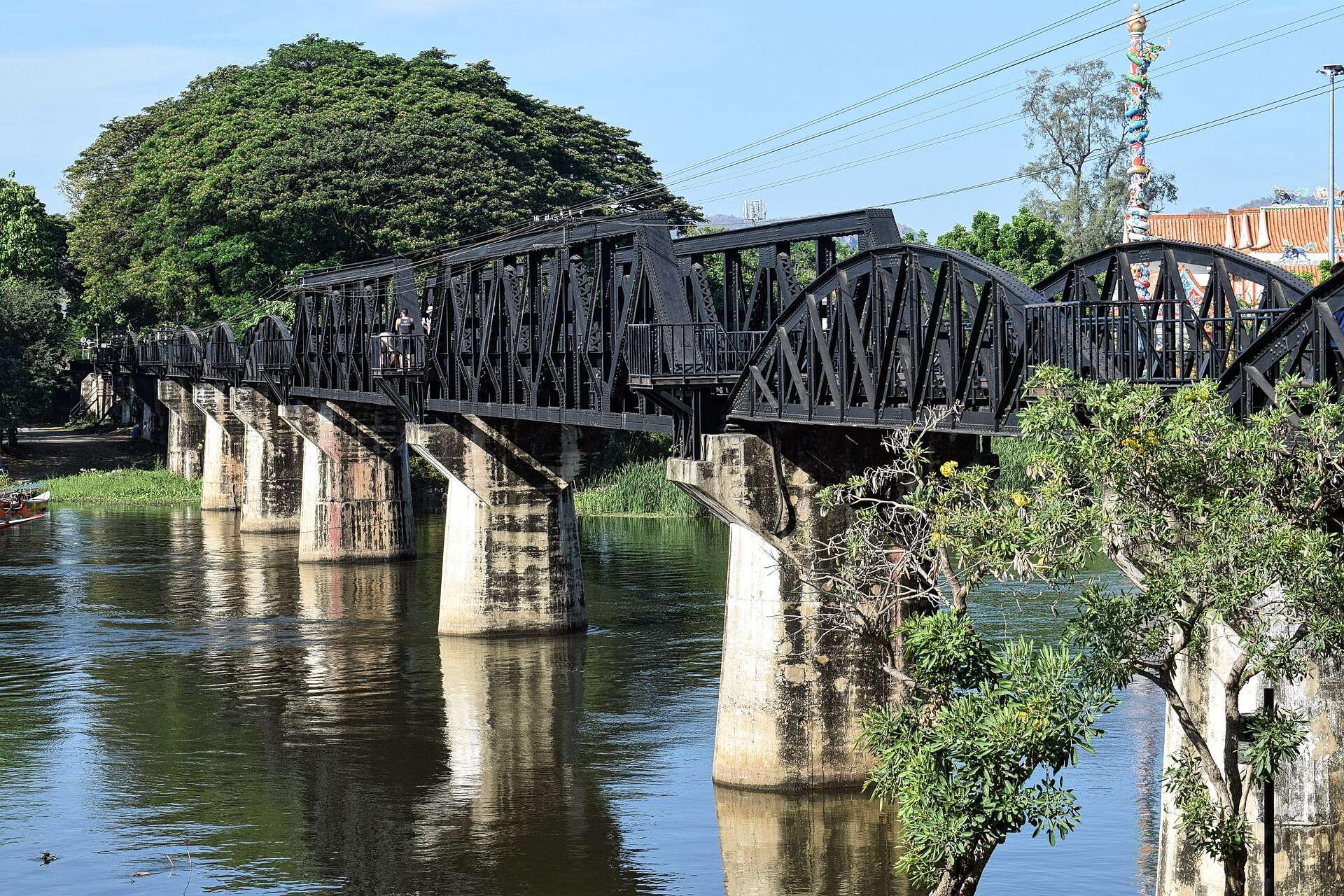
- The bridge over the Khwae — bombed, rebuilt, and walkable between train passings — is the famous image; the film that made it famous took its liberties, and the museum sorts fact from screenplay.
- Hellfire Pass, the deepest cutting, lies about 80 kilometers beyond town — its memorial museum and walking trail are the railway’s most affecting ground, and honestly reachable only by tour or hired driver as an extension, not an afterthought.

Getting there
The train from Thonburi is the fitting approach: three unhurried hours on the line the story is about, ending with the crossing of the bridge itself. Two departures a day set the schedule — the early one makes the full visit; confirm the return time on arrival, and hold the bus as the flexible backup. Organized day tours from Bangkok compress bridge, cemetery, and museum efficiently and add Hellfire Pass on the longer versions — one of the cases where the tour format serves the subject, provided the operator treats the sites as memorials rather than photo stops.
The visit
Begin at the war cemetery and let the scale register — the ages on the headstones do the arithmetic no plaque can. The Thailand–Burma Railway Centre next door supplies the history with precision: the route, the camps, cholera and the monsoon of 1943, the speedo period when the line’s cost climbed steepest. Then the bridge, walked between the scheduled trains, holding what you now know against what the postcards show. If the day extends to Hellfire Pass, the Australian-built interpretive centre and the walk through the cutting — tool marks still in the rock — is the railway at its most direct; allow three hours plus the drive. Return to Bangkok in the evening; the day does not pair with anything, and should not.
Practical notes
The town sites — cemetery, museum, bridge — sit within a short songthaew or samlor ride of the station and each other. Dress and conduct follow the setting: the cemetery is a working war grave site, and the museum should be taken as quietly as the cemetery. The floating restaurants and raft hotels along the river run a resort economy alongside the memorials; scheduling them after the serious visit, not between its parts, keeps the day coherent. The tourist-line train onward from Kanchanaburi over the Wampo viaduct is historically genuine and visually dramatic — ride it with the same understanding you brought to the bridge.
Frequently Asked Questions
Is the bridge the actual bridge?
The steel bridge standing today is the wartime structure, bombed by the Allies in 1945 and repaired after — the curved spans are original, the angular ones replacements. The wooden bridge of the film never stood here; the museum explains the history the novel rearranged.
Should I include Hellfire Pass?
If your schedule allows the long version, it is the most important ground on the railway — the cutting, the memorial, and the audio walk built from survivors’ accounts. As an 80-kilometer extension it needs a tour or driver; day-trippers on the train reasonably hold it for a dedicated visit.
Is the train ride itself appropriate — it seems like tourism on a graveyard?
The line’s continued civilian use is part of the region’s life, and riding it with the history in mind is remembrance, not trespass. The museum’s own position is that understanding requires visiting; the conduct you bring settles the rest.
What about the JEATH museum and other sites?
The bamboo-hut JEATH museum is older and rougher; the Railway Centre supersedes it for accuracy. The Chungkai cemetery across the river, quieter still, holds 1,400 more graves for those extending the visit.
Can this be done as a half day?
The travel alone forbids it — three hours each way. Treat it as the full day it is, or leave it for a trip that can. The subject does not reward hurrying.